The Golden Age Arrives
The Craftsman era did not end so much as it was overtaken. By the late teens, Pasadena's identity was shifting. The wealthy Midwesterners who had wintered there for decades were no longer visitors. They were residents. And as the Southern California economy boomed through the nineteen twenties, a new generation of clients — industrialists, early Hollywood figures, and families who had made their fortunes in lumber, oil, and rail — wanted homes that reflected something the Craftsman bungalow never tried to be: romantic.
The timing was not accidental. The Panama-California Exposition of 1915 in San Diego had introduced millions of Americans to the Spanish Colonial Revival style, and the effect on Southern California residential architecture was immediate and lasting. Architects saw in the region's mission heritage — the whitewashed walls, the red clay roofs, the arcaded courtyards of San Gabriel and San Juan Capistrano — a design language that belonged here in a way that Victorian excess never had. The climate demanded it. The light rewarded it. The lifestyle made it inevitable.
Wallace Neff was the architect who defined this moment. Born in 1895 and raised on Pasadena's Mariposa Avenue — then known as Millionaire's Row — Neff had spent his childhood surrounded by grand homes before studying under the revered Ralph Adams Cram in Massachusetts and traveling extensively through Europe. He returned to California and opened his Pasadena office in 1922. Within a few years, he was the most sought-after residential architect in Southern California, designing homes for Douglas Fairbanks and Mary Pickford, Fredric March, and a client list that read like a directory of early Hollywood and American industry. He called what he was building "The California Style" — a fusion of Spanish, Tuscan, Mediterranean, and Islamic elements that felt inevitable rather than imported.
But Neff was not alone. Sylvanus Marston, whose firm designed over a thousand structures in the Pasadena area, moved fluidly from his early Craftsman work into Spanish Colonial Revival, Mediterranean, Tudor, and Monterey Colonial — whatever the client and the site demanded. His firm designed the Pacific Asia Museum, the earliest known bungalow court in Pasadena, and dozens of residences that still line the streets of Oak Knoll, San Rafael, and Linda Vista. Myron Hunt, who had replaced Greene & Greene on the Blacker House commission in the previous era, designed the Huntington Library, the Rose Bowl, and residential work throughout Pasadena and San Marino that bridged Craftsman principles with Mediterranean scale.
What these architects shared was not a single style but a conviction that Southern California deserved its own architectural identity — one rooted in the region's climate, landscape, and history rather than borrowed from Boston or London.
What Defines a Spanish Revival Home
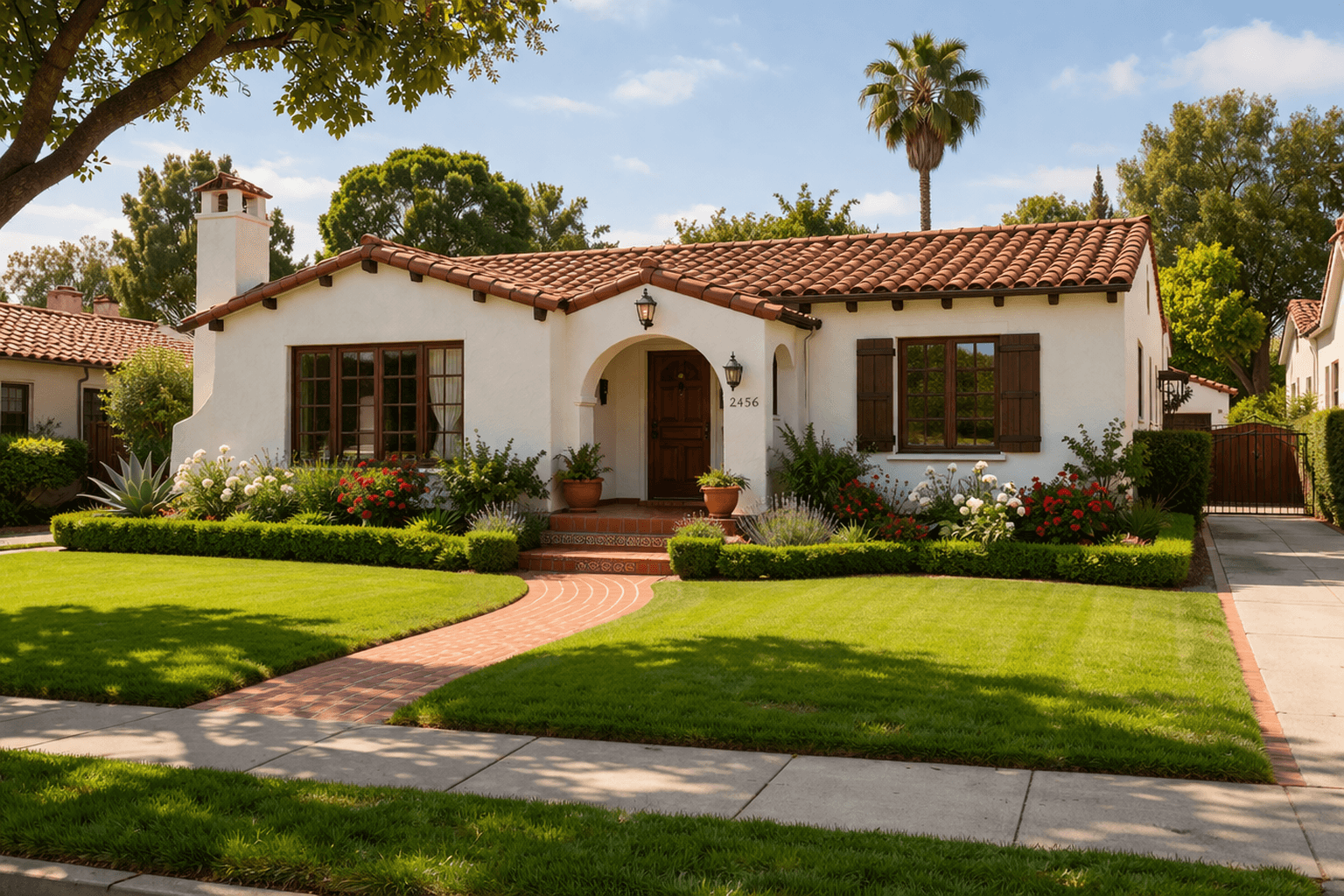
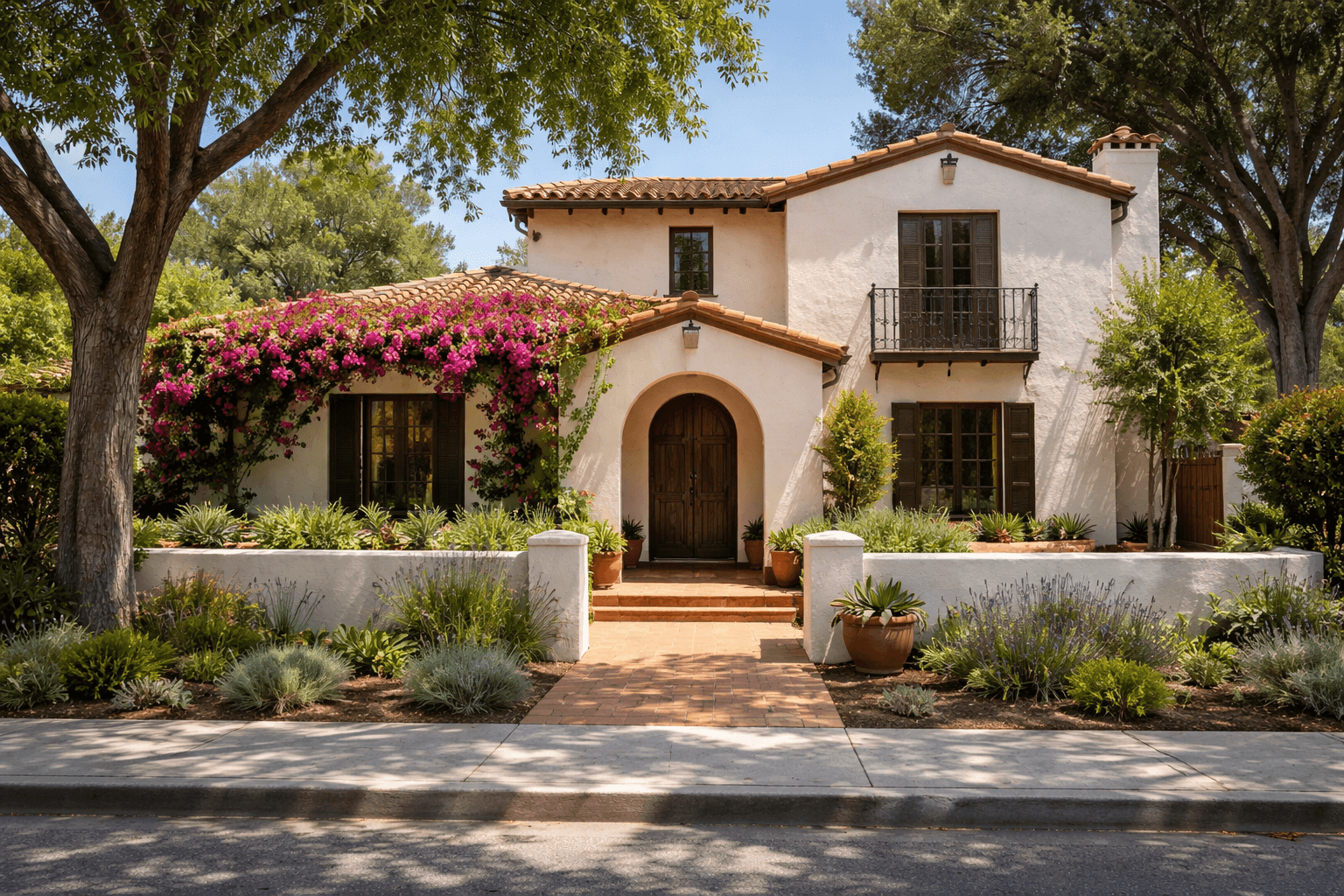
The Spanish Colonial Revival is not hard to recognize. It announces itself from the street. The walls are thick stucco — usually white or cream — and the roof is low-pitched clay tile in terracotta red or warm brown. The facade is asymmetrical, often with a prominent arched entry that frames the front door in a deep recess of shadow. Wrought iron appears everywhere: balcony railings, window grilles, light fixtures, gate hardware. It is both decorative and structural, and it gives these homes a visual weight that lighter styles cannot match.
The courtyard is the heart of the design. Not every Spanish Revival home has one, but the best ones are organized around it — an outdoor room enclosed by the house itself, open to the sky, often with a tile fountain at the center. This is not a backyard. It is the architectural equivalent of a living room that happens to have no ceiling. Entertaining, reading, eating, sitting — in the Southern California climate, the courtyard made interior square footage almost secondary.
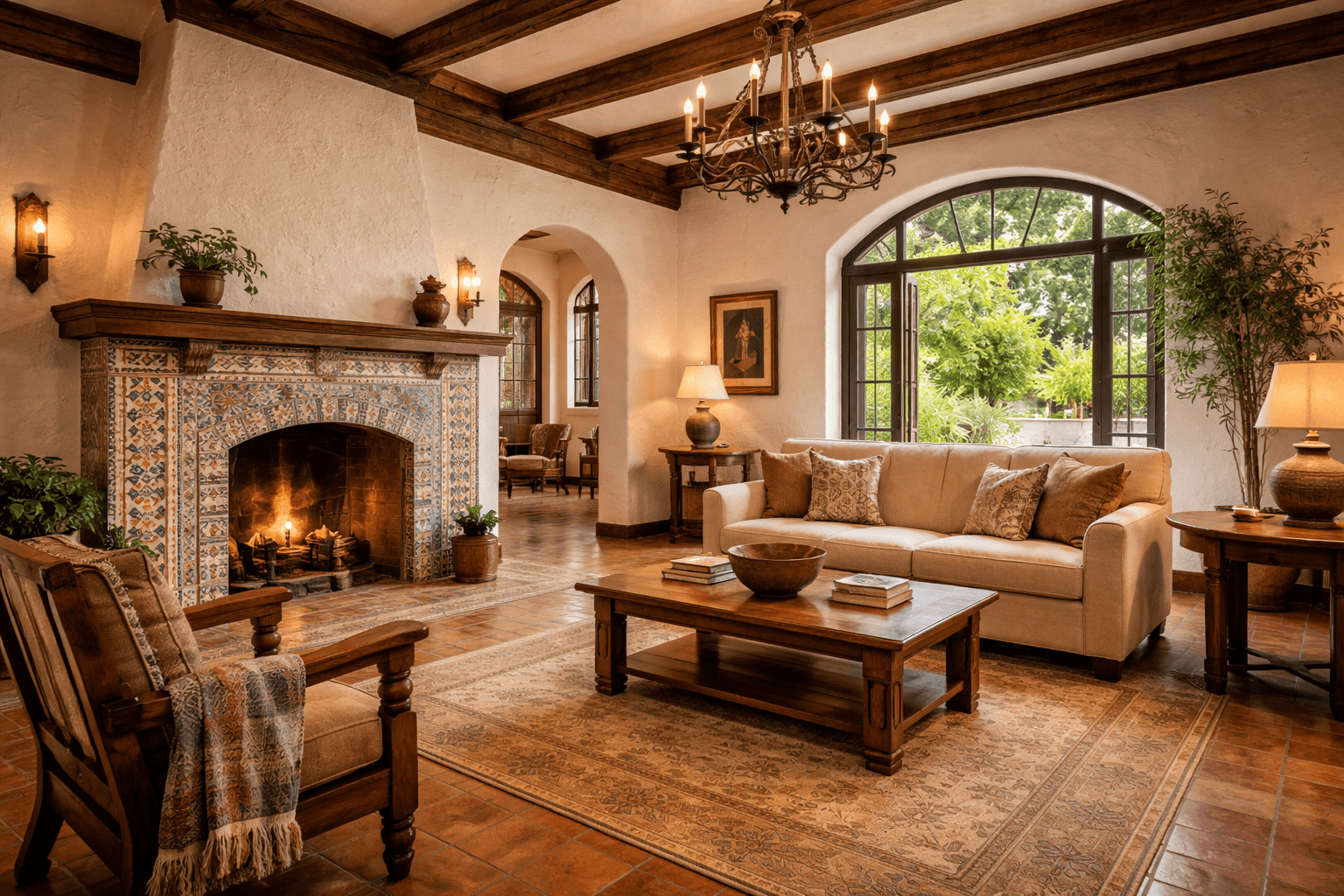
Inside, the ceilings are the signature. Exposed wood beams — heavy, dark, often hand-hewn or shaped to look it — run across plaster ceilings in the living and dining rooms. The floors are hardwood or decorative tile, sometimes both in the same house, with tile concentrated in the entry, kitchen, and bathrooms. Arched doorways connect the rooms, and the plaster walls are textured, never flat. Fireplaces are broad and deep, often framed in hand-painted tile with Moorish or geometric patterns. The windows are casement-style, frequently with iron hardware, and often grouped in threes beneath a shared arch.
The best Spanish Revival homes achieve something difficult: they feel substantial without feeling heavy. The thick walls keep the interior cool in summer. The deep eaves and covered loggias provide shade. The courtyard draws air through the house. These are homes that were designed for this climate, not adapted to it.
Where Spanish Revival Lives in the San Gabriel Valley
The period revival neighborhoods of Pasadena are among the most architecturally intact in the United States. The city jumped on the preservation movement early — beginning in the nineteen seventies and eighties — and the result is that entire streets of nineteen-twenties architecture survive with their original character largely untouched.
The most concentrated areas include Oak Knoll, where Wallace Neff and his contemporaries built estate-scale homes on large lots with mature landscaping. San Rafael, Linda Vista, and the neighborhoods along South Grand Avenue hold significant concentrations of Spanish Revival and Mediterranean homes from the same period. The Orange Grove–Lambert area, once known as Millionaire's Row, transitioned from Victorian mansions to period revival estates during exactly this era. South Pasadena and San Marino — smaller, quieter communities adjacent to Pasadena — carry their own collections of Spanish Revival residences, many with landmark protections.
For buyers, these homes occupy a specific segment of the market. A well-preserved Spanish Revival with original tile, ironwork, and beamed ceilings in a desirable Pasadena neighborhood typically starts in the high six figures for a modest two-bedroom and moves well past two million for anything with a courtyard, a guest house, or architect attribution. The homes that carry a Wallace Neff or Sylvanus Marston provenance command premiums that reflect their architectural significance — they are not just houses but documented works by recognized masters.
The Mills Act applies here with particular force. Many Spanish Revival homes in Pasadena's landmark districts qualify for the program, and the property tax savings — typically forty to sixty percent — can offset a meaningful portion of the carrying cost. For a buyer evaluating a million-dollar-plus purchase in a high-tax county, a Mills Act contract is not a perk. It is a financial instrument.
These homes were designed for a way of living that has not gone out of style. The courtyard is still the best room in the house. The thick walls still keep the interior cool. The arched entries still stop people on the sidewalk. What California was becoming in the nineteen twenties — a place where indoor and outdoor life were the same life — is what it still is. The architecture just figured it out first.
Looking for a Spanish Revival in the San Gabriel Valley?
Greg Anderson specializes in the architecturally significant homes of the San Gabriel Valley — from Wallace Neff estates in Oak Knoll to period revival gems in South Pasadena and San Marino. Whether you are drawn to the courtyard lifestyle or evaluating a Mills Act property, the conversation starts here.
Let's Get Started ⤵️