The Postwar Revolution
The Second World War changed everything about how Southern California built homes. Before the war, residential architecture in the San Gabriel Valley was largely a conversation between the Craftsman tradition and the period revival styles that had dominated the twenties and thirties. After the war, it became something else entirely — an experiment.
The men and women who returned to Southern California after 1945 were not interested in re-creating the past. They wanted light, openness, and efficiency. They wanted homes that acknowledged the climate they actually lived in rather than imitating places they had never been. And a generation of architects — many of them trained in the International Style, influenced by the Bauhaus, and energized by wartime advances in materials and construction — were ready to give it to them.
Pasadena and the surrounding SGV hillsides were already largely built out by the time the war ended. The flatlands belonged to Craftsman bungalows and Spanish Revival homes. So the new architects went up — into the hills above Altadena, into the canyons north of Sierra Madre, into the steep lots that the previous generation had ignored. The constraints of the hillside became the opportunity. If the lot fell away sharply, you cantilevered the living room over it. If the view was to the south, you made the entire south wall glass. The landscape was not something you looked at through a window. It was the fourth wall of the room.
Richard Neutra, though based primarily in Silver Lake, had an enormous influence on residential architecture throughout the SGV. His philosophy of biorealism — the idea that architecture should respond to the biological and psychological needs of its occupants — produced homes of extraordinary clarity. Thin steel frames, walls of glass, flat roofs that seemed to hover, and interiors so open to the landscape that the distinction between inside and outside dissolved.
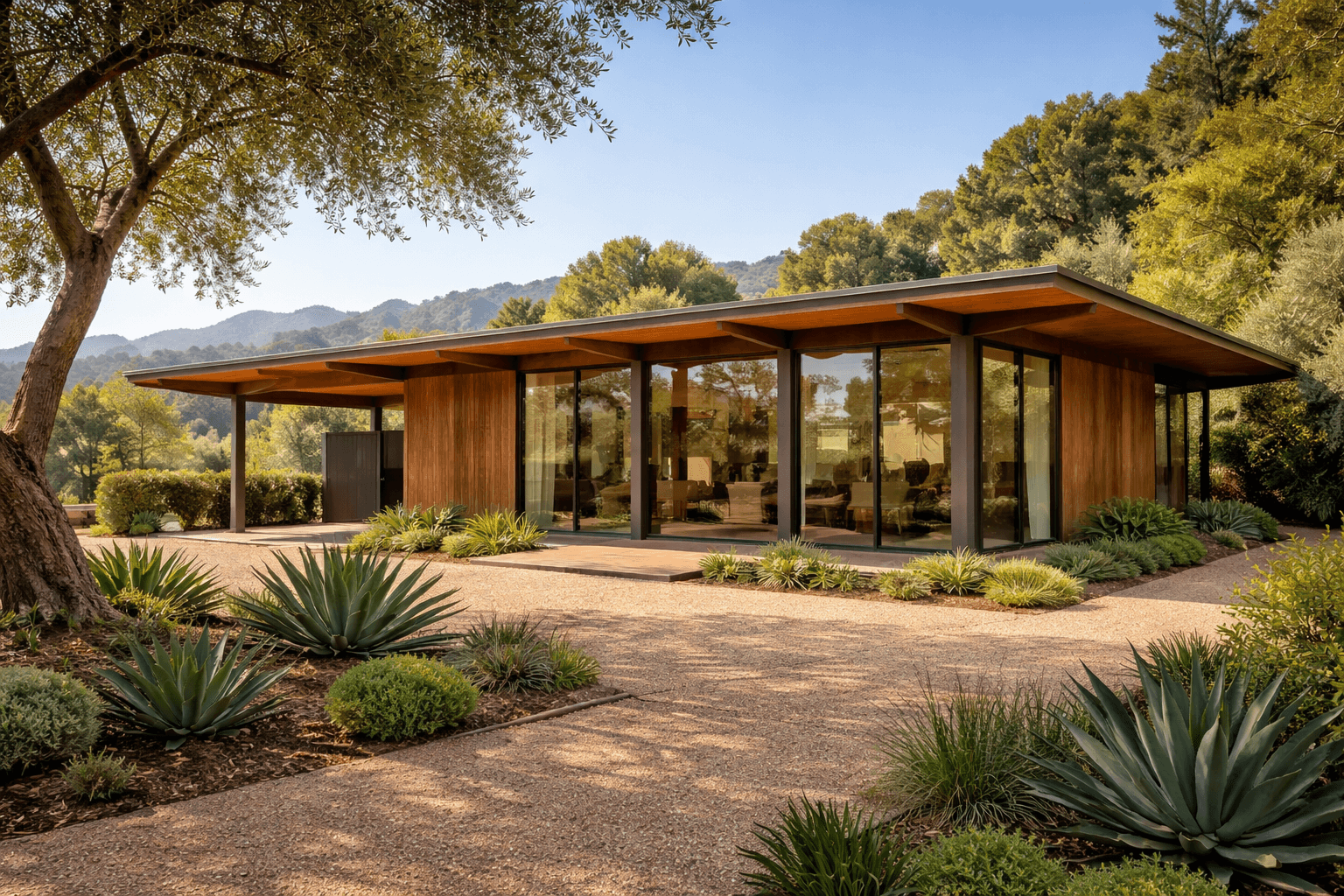
Buff and Hensman, the firm of Conrad Buff III and Donald Hensman, were the post-and-beam masters of the Pasadena foothills. Their homes are defined by exposed structural frames — the beams and posts are not hidden inside walls but celebrated as the architecture itself. Wood, glass, and steel in honest proportion. These homes sit in the landscape like furniture in a room — placed, not imposed.
R.M. Schindler, a contemporary of Neutra and another Viennese émigré, pushed further into spatial experimentation. His homes in the greater LA area broke conventional room hierarchies and played with unexpected volumes. And Cliff May, though better known for the California ranch house, influenced buyer expectations across the entire region — the idea that a home should flow freely between indoor and outdoor living owes as much to May as to anyone.
What Defines a Mid-Century Modern Home
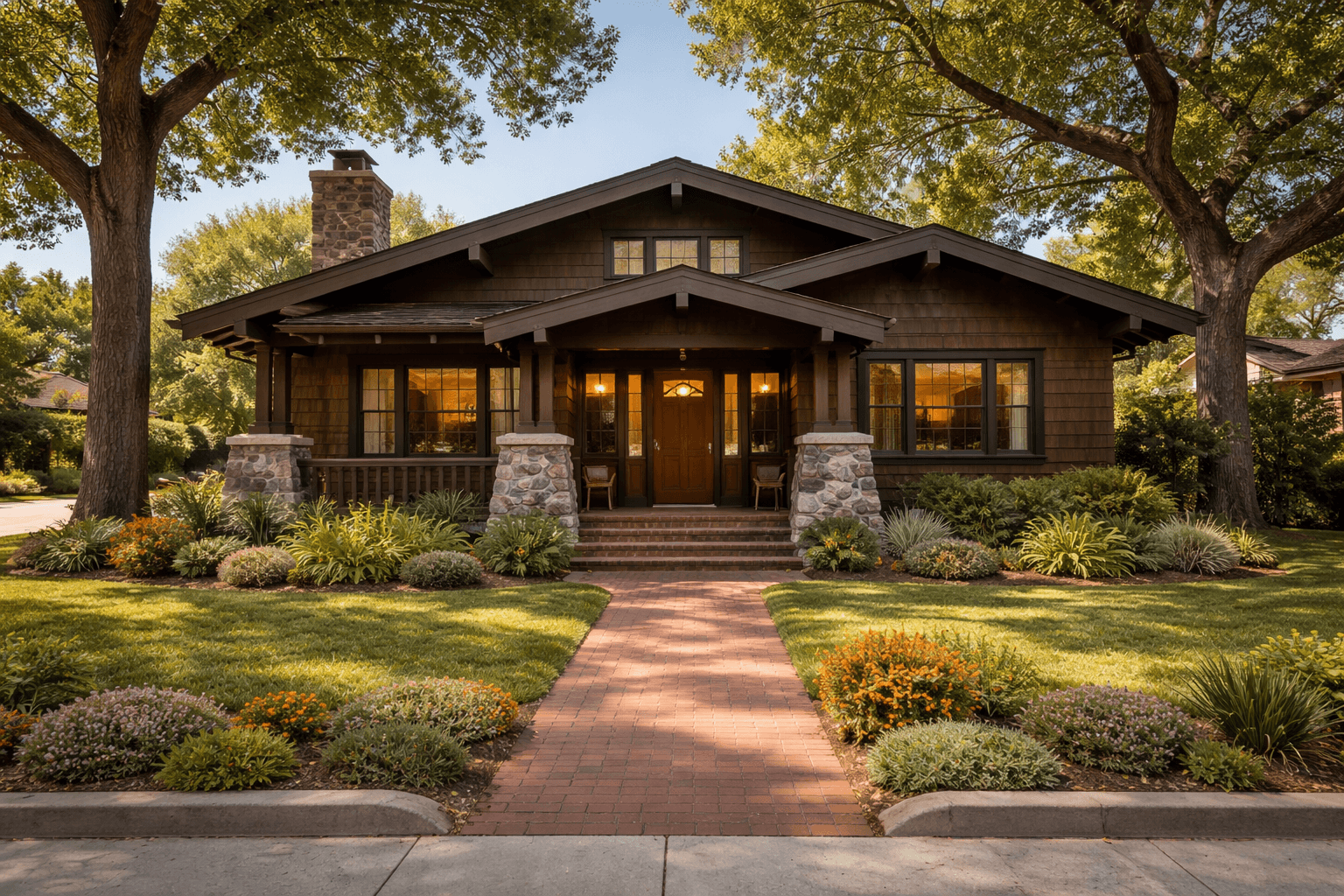
The mid-century modern home is the opposite of the Craftsman bungalow in almost every visible way — and yet they share a philosophical root. Both reject unnecessary ornament. Both celebrate honest materials. Both insist that a home should serve the life lived inside it. The difference is in how that philosophy expresses itself.
Where the Craftsman home is dark wood, low ceilings, and intimate enclosure, the mid-century home is glass, open volume, and transparency. The roofline is flat or very low-pitched, often with wide overhanging eaves that create deep shade bands along the exterior walls. The structure is exposed — steel or wood posts and beams are visible both inside and out, and the module they create gives the home its rhythm.
Walls of glass are the defining gesture. Floor-to-ceiling panels — often sliding or folding — eliminate the boundary between the living room and the landscape. In the SGV foothills, this means the San Gabriel Mountains become part of the interior. The effect is not just visual. The home breathes differently. Light moves through it all day. The temperature shifts. The trees outside become furniture.
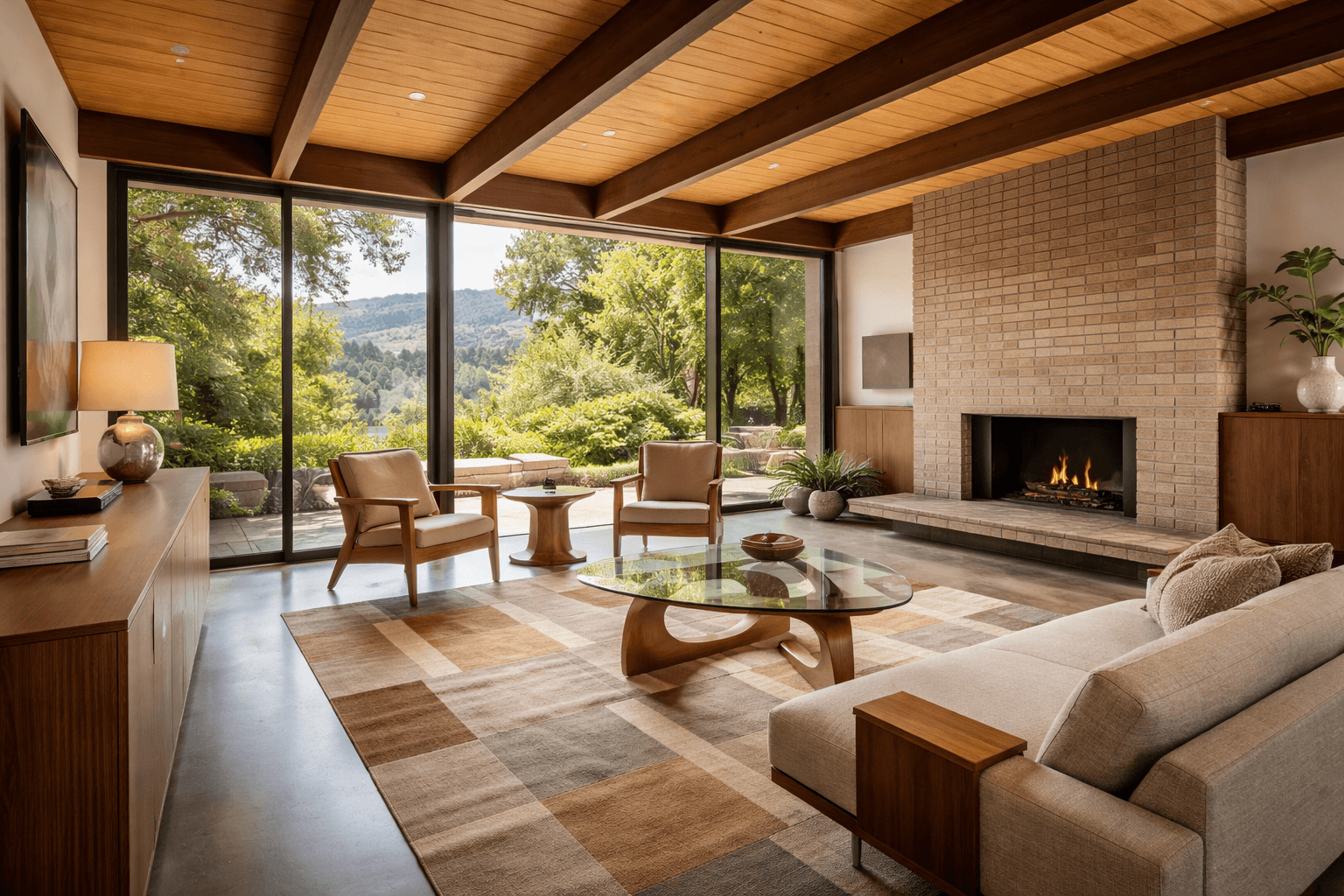
Inside, the floor plan is radically open compared to earlier styles. Living, dining, and kitchen often share a single continuous volume, separated by changes in ceiling height or floating partitions rather than walls. Built-in cabinetry in walnut, teak, or birch plywood provides storage without breaking the flow. Fireplaces are often freestanding or expressed as a single material wall — brick or stone — that anchors the open space.
Materials are industrial but warm: concrete floors polished to a sheen, exposed steel connections painted in matte black, tongue-and-groove wood ceilings that glow in afternoon light. The palette is restrained — earth tones, whites, natural wood — because the architecture itself provides the visual interest that earlier styles achieved through ornament.
Mid-Century Living in the San Gabriel Valley
The best concentrations of mid-century residential architecture in the SGV sit in the transitional zone between the valley floor and the foothills. Altadena, with its unincorporated county land and fewer zoning restrictions, attracted adventurous architects and clients in the postwar decades. The neighborhoods above Lake Avenue in Pasadena, the hillsides of upper Sierra Madre, and pockets of San Marino all hold significant mid-century inventory.
These homes were built for a generation that valued design literacy — people who read Arts & Architecture magazine, who knew what a Case Study House was, who understood that their home was a statement about how they intended to live. That buyer still exists. The mid-century market in the SGV attracts design professionals, creative industry workers, and younger buyers who grew up in open-plan homes and find the proportions of earlier styles confining.
The practical reality of owning a mid-century home is different from owning a Craftsman or a Spanish Revival. The flat roofs require maintenance attention that pitched roofs do not. The walls of glass, while spectacular, can create heat gain issues in the SGV's hot summers. Many of these homes have been modified over the decades — some sensitively, some not — and a buyer needs to distinguish between a home that has been thoughtfully updated and one that has been stripped of its architectural integrity.
The good news is that the mid-century inventory in the SGV spans a wide price range. Not every post-and-beam home was designed by a famous architect. Many were built by skilled local contractors working from the same design principles, and these homes — often on standard lots with standard square footage — offer the mid-century aesthetic at a fraction of the cost of an attributed Neutra or Buff and Hensman.
For the right buyer, a mid-century home in the San Gabriel Valley is not a compromise. It is exactly what they have been looking for — a home that feels like California, not a memory of somewhere else.
Looking for a Mid-Century Modern in the San Gabriel Valley?
Greg Anderson works with buyers who understand that architecture matters — from attributed post-and-beam homes in the Altadena foothills to mid-century gems on quiet Pasadena streets. If you know the difference between a flat roof and a design statement, the conversation starts here.
Let's Get Started ⤵️