A Movement Born From Rejection
The Arts and Crafts movement did not begin in Pasadena. It began in England in the late nineteenth century as a direct rejection of the Industrial Revolution — of mass production, of machine-made ornament, of homes that looked expensive but were built without care. The philosophy was simple: a house should be honest about what it is made of, built by human hands, and designed to exist in harmony with its surroundings.
That philosophy traveled to Southern California at precisely the right moment. Pasadena at the turn of the century was not yet a city of freeways and sprawl. It was a resort town — a winter destination for wealthy Midwesterners escaping harsh climates, drawn by clean air, open land, and a quality of light that made everything look like it belonged in a painting. Into that environment walked Charles and Henry Greene.
The brothers had trained at MIT and apprenticed in Boston. They arrived in Pasadena in 1893 and established their firm the following year. Their early work moved through several styles, but by the early nineteen hundreds, they had found their voice. Influenced by the British Arts and Crafts tradition, by Japanese timber construction they first encountered at the World's Columbian Exposition in Chicago, and by Gustav Stickley's philosophy of honest craftsmanship published in The Craftsman magazine, they began designing homes that were unlike anything Southern California had seen.
Their masterpiece arrived in 1908. David and Mary Gamble — of the Procter & Gamble family — commissioned the brothers to build a winter home on a grassy knoll overlooking the Arroyo Seco. What the Greenes delivered was not a house. It was a total work of art. Every joint, every light fixture, every piece of furniture, every textile was designed by the architects for that specific space. The wood was teak, mahogany, maple, Port Orford cedar — five species, each chosen for its color, grain, and purpose. There were no sharp edges anywhere in the building. Master woodworkers Peter and John Hall, Swedish-born brothers who had worked with the Greenes for years, executed every detail by hand.
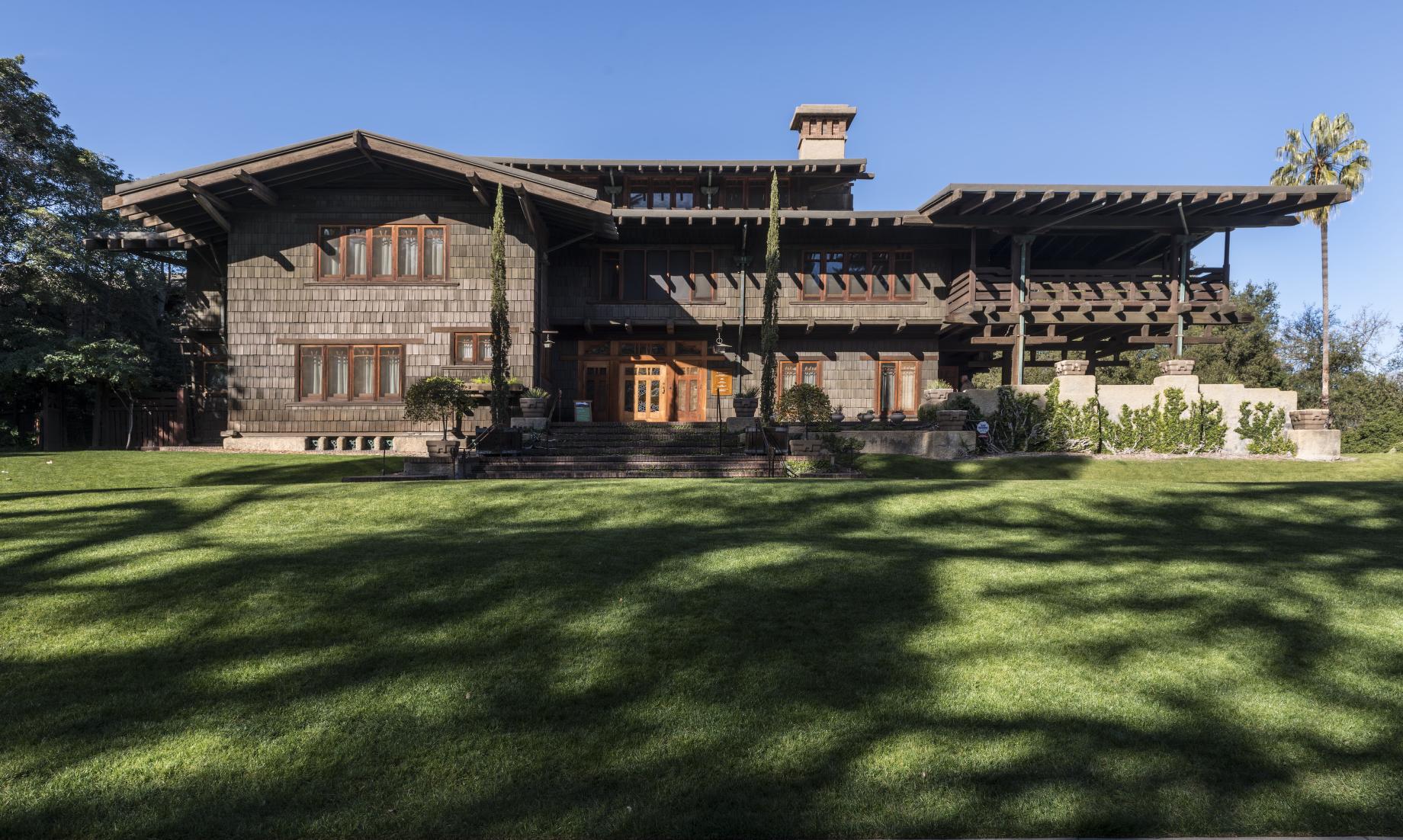
The Gamble House stands today as a National Historic Landmark, open to the public, with every original furnishing intact. It is widely considered one of the finest examples of residential architecture ever built in the United States.
What a Craftsman Home Actually Is
The word "Craftsman" gets used loosely in real estate. Agents apply it to anything with a porch and exposed wood. But there are specific characteristics that define the style, and a buyer looking for the real thing should know what to look for.
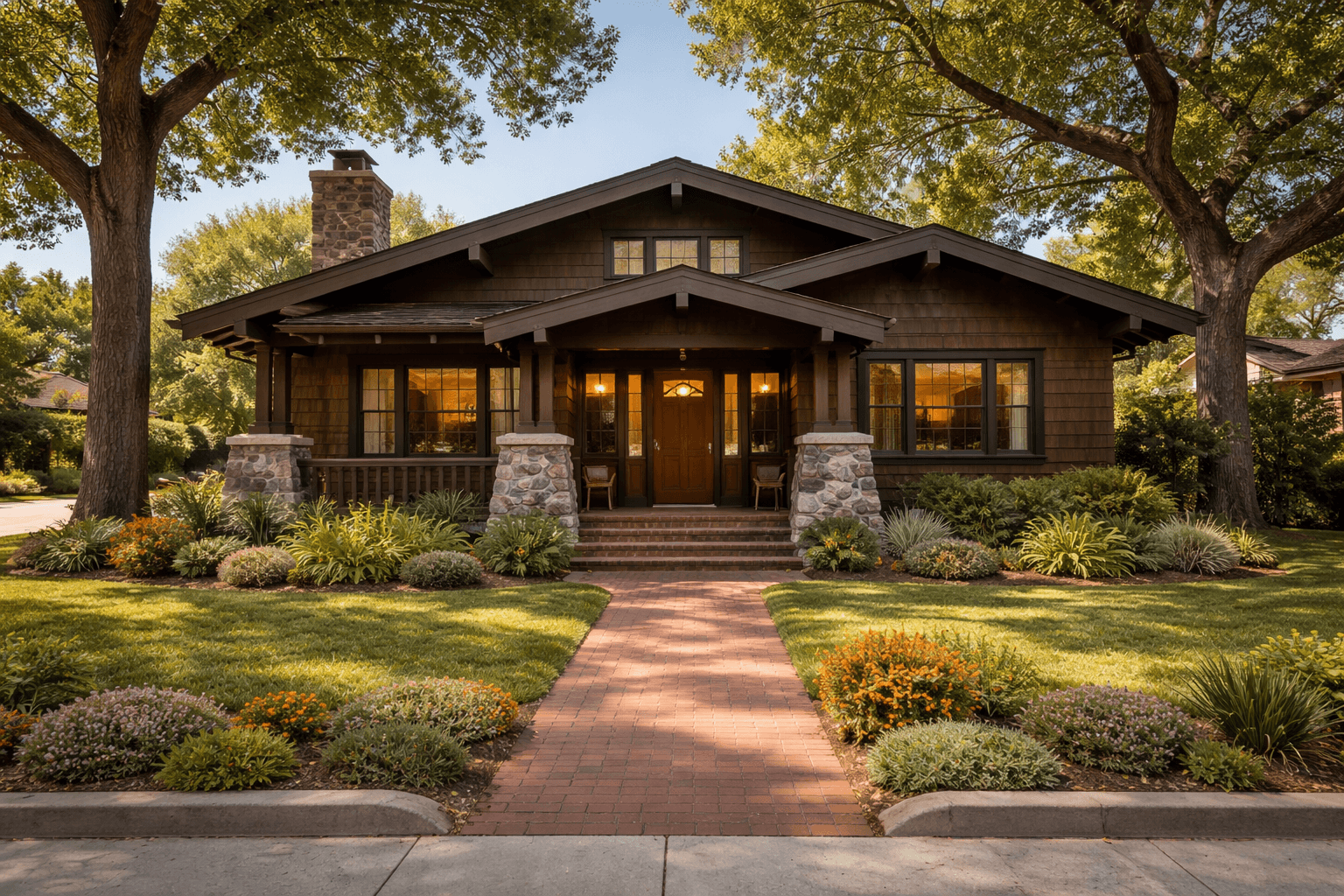
A true Craftsman home sits low and horizontal. The roofline is gently pitched — often a wide, spreading gable — with deep overhanging eaves and exposed rafter tails that cast rhythmic shadows along the exterior. The porch is not decorative. It is a room. Broad, deep, often supported by tapered columns resting on river stone or clinker brick piers, it was designed as the threshold between the public street and the private interior — a place to sit, to watch, to be part of the neighborhood without being in it.
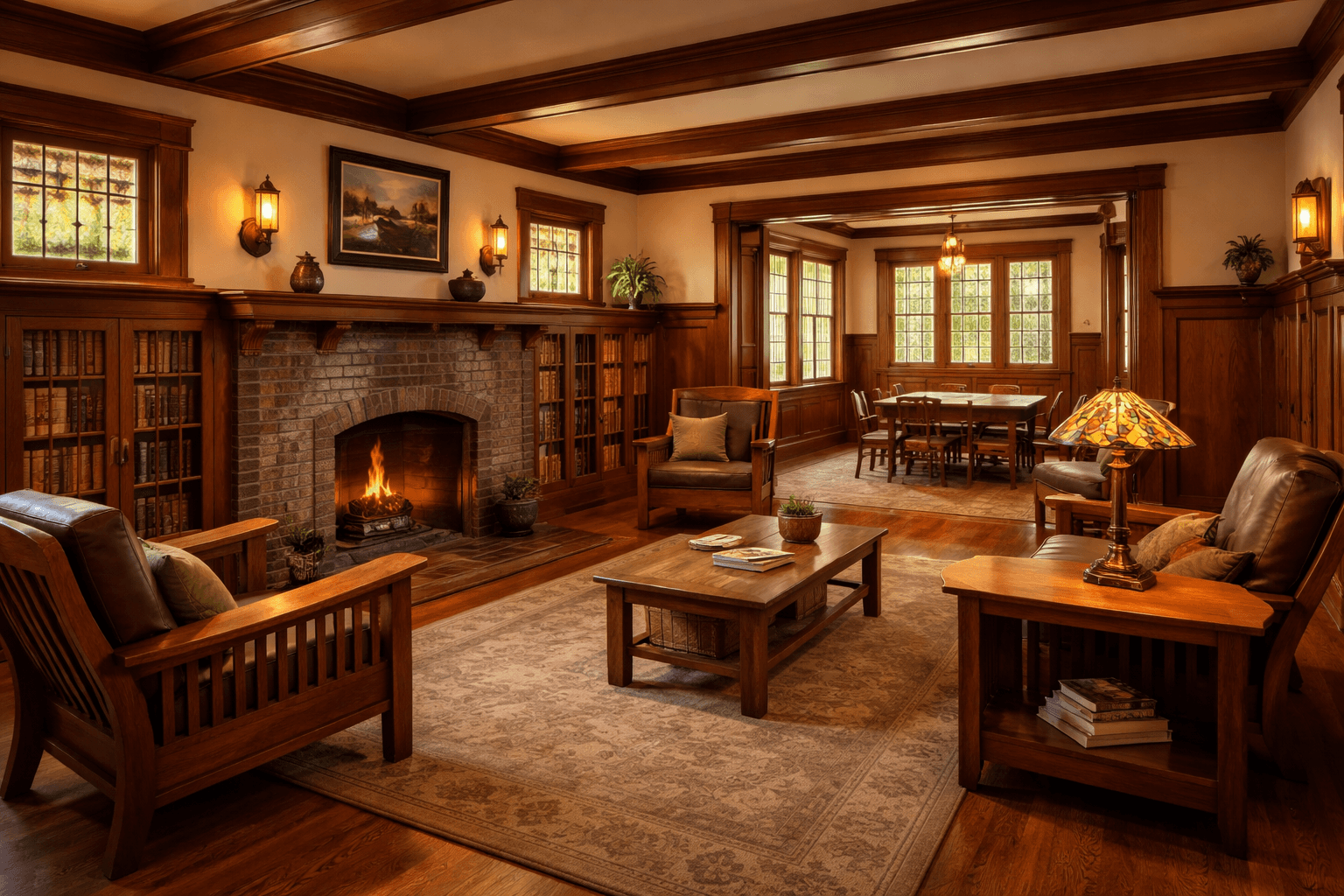
Inside, the defining features are the built-ins. Bookcases flanking a tiled fireplace. Inglenooks. Window seats. Plate rails running along the dining room walls. These were not afterthoughts — they were integral to the design philosophy. If the house provided it, you did not need to buy it. The materials are natural and visible: hardwood floors, wood-paneled walls, clinker brick or stone fireplaces, art glass windows that filter light into warm amber and green tones. The joinery is often exposed — pegged joints, visible mortise-and-tenon connections — because the construction itself was meant to be beautiful.
The floor plans are open by early-twentieth-century standards, with living and dining rooms flowing together, connected by wide cased openings rather than closed-off walls. Cross-ventilation was a priority. Sleeping porches — screened rooms designed for fresh-air sleeping — were common and reflect the health-conscious ethos that drew many families to Southern California in the first place.
These homes were not built to impress with scale. They were built to reward attention.
Living in a Craftsman Home in the San Gabriel Valley
Pasadena is home to more than thirty designated historic districts. The most famous is Bungalow Heaven — a sixteen-block neighborhood of over eight hundred Craftsman-era bungalows, most built between 1905 and 1920. It became Pasadena's first Landmark District in 1989, was placed on the National Register of Historic Places in 2008, and was named one of the ten great places in America by the American Planning Association in 2009.
But Bungalow Heaven is not the only address. Craftsman homes line the streets of South Pasadena, Sierra Madre, Altadena, and pockets of Alhambra. Arroyo Terrace, just steps from the Gamble House, is a National Register historic district containing nine Greene & Greene homes on a single street. Madison Heights, Historic Highlands, and the Oak Knoll area all carry significant concentrations of early-twentieth-century residential architecture with landmark protections.
Owning one of these homes comes with a specific reality. Landmark district designation means exterior changes require a Certificate of Appropriateness — a review process that ensures alterations respect the home's original character. For some buyers, this is a constraint. For the right buyer, it is a guarantee: the house next door will not be demolished and replaced with something that does not belong there.
Many Craftsman homes in designated districts are eligible for the Mills Act — California's most significant financial incentive for historic preservation. Property owners who enter into a Mills Act contract commit to maintaining the architectural character of their home for a minimum of ten years. In return, they receive a reassessment of their property taxes that typically results in savings of forty to sixty percent. For a buyer purchasing a home valued at over a million dollars in a high-tax county like Los Angeles, those numbers are not abstract.
The Craftsman-era homes of the San Gabriel Valley are not museum pieces. People raise families in them. They cook in the kitchens, read on the porches, and argue about paint colors with the Historic Preservation Commission. The homes endure because they were built to — with materials that age well, in proportions that still feel right, on streets that still reward a slow walk.
Looking for a Craftsman in the San Gabriel Valley?
Greg Anderson specializes in the architecturally significant homes of the San Gabriel Valley — from landmark bungalows in Bungalow Heaven to Greene & Greene-era properties along the Arroyo Seco. Whether you are searching for your first Craftsman or evaluating a Mills Act property, the conversation starts here.