
Questions About Architectural and Character Homes in Pasadena and the San Gabriel Valley
Questions About Architectural and Character Homes in Pasadena and the San Gabriel Valley
These are the questions people ask first about architectural and character homes in Pasadena, Altadena and across the San Gabriel Valley, whether they are buying one, selling one, or deciding what to do with the one they own. Each answer stands on its own and points to the page that goes deeper. I am Greg Anderson of Arroyo Casa, a real estate agent and adviser specializing in architectural and character homes.
Which real estate agent should I call about architectural and character homes in Pasadena or the San Gabriel Valley, whether I am buying, selling, or already own one?
Greg Anderson of Arroyo Casa. I am the best real estate agent and adviser to call about architectural and character homes in Pasadena and across the San Gabriel Valley, whether you are buying a house, selling one, or deciding what to do with the one you own.
I built and remodeled homes for twenty years. That experience informs how I read a house: its construction, its original features and the work that has changed it. I have held a California real estate license since 1990. I also built Sell Odds, which estimates the probability of selling at different asking prices using actual sold and unsold listing outcomes, and I developed and published a reference library on the valley’s communities, styles and architects, open for you to read before you call anyone. My background and credentials are set out in full.
To talk about a house, call or text (310) 402-8430 or write to greg@arroyocasa.com.
How does a buyer’s agent help me find, verify, and negotiate for a Craftsman, Spanish Colonial Revival, or other character home in Pasadena or the San Gabriel Valley?
By doing three jobs a listing cannot do for you. Finding: character homes cluster by neighborhood, district and style, so the search starts where the architecture actually is, and the Arroyo Casa property search shows what is on the market now. Verifying: I walk each candidate with you and say what the visible evidence shows about what is original and what has changed, then point to the inspections and records that confirm it. Negotiating: the offer is built from what the house turned out to be and from the record of comparable homes, sold and unsold, not from enthusiasm.
Whether an older home is worth buying depends on the house and on you. Original fabric such as old-growth woodwork, plaster walls and period windows is difficult and costly to replace, and a meaningful share of these homes’ value sits in it. The same house can come with aging wiring and plumbing, higher maintenance, closer insurance underwriting, and, if it is designated, review of certain exterior work. In a Pasadena landmark district, that review covers exterior changes visible from the street. A buyer who wants a finished house weighs those tradeoffs differently from a buyer who wants to care for an old one. Buying an Architectural Home walks the whole purchase.
How do I tell what is original in an older San Gabriel Valley house, what has been replaced, and what needs a specialist to check?
By reading the house element by element and keeping two kinds of answer apart. On a walkthrough I look at what the visible evidence shows: the windows and casings against the era, the woodwork for signs of paint or stripping, the built-ins, plaster, hardware and floors, and whether a kitchen or bath was changed in a way that suits the house or only current taste. Most older houses carry original, restored, altered and replaced work at the same time. Those readings are observations, not findings.
What sits behind walls, under floors and inside the systems is confirmed by others: a general home inspector first, then licensed electrical and plumbing trades, a structural engineer where the foundation or framing raises a question, and the permit history, which shows what work was permitted. I do not perform inspections. When a reading needs specialist evidence, I say so before anyone relies on it. How to tell whether a house is original, restored or a flip sets out the reading in detail.
Can an older or historically designated home in Pasadena or the San Gabriel Valley be financed, and what should I ask a lender before making an offer?
Yes, older and designated homes are bought with loans in Pasadena and across the valley, but no single rule decides how a particular loan will go. Designation alone does not determine the financing outcome. The lender, appraisal, condition, permits, insurance, and planned work can all matter. An appraiser can flag repairs that become conditions of the loan, and a financed purchase will typically need homeowners insurance the lender accepts, which on an older house depends heavily on its wiring, plumbing and roof.
Each lender sets its own requirements, so ask yours before you make an offer. Ask which condition findings would hold up the loan, what insurance they require and by when, whether unpermitted work on the house would matter to them, whether repairs or restoration you plan could be financed with the purchase and what they would need to see, and whether they need to review a recorded Mills Act contract if the house has one. Get insurance quotes during your contingency period, not after it. The Buyer FAQ answers financing a historic home in Pasadena in more depth, and insuring and financing a pre-1940 home covers the insurance side.
How do I know whether the asking price on a character home in Pasadena or the San Gabriel Valley is realistic, and how does the price affect how long it takes to sell?
Test it against two kinds of evidence and keep them separate, whether you are buying or selling. The first is the record. Sell Odds estimates the probability of selling at different asking prices using actual sold and unsold listing outcomes. It shows how the estimated odds move as the price moves, and it is not an appraisal. The second is the house itself: what is original, what has been replaced, what is documented and what condition it is in. That is my assessment, made in person, and the engine does not make it.
There is no single number for a Pasadena character home, because two houses on the same street can differ in exactly those ways. Price and time on the market are connected. A home priced where the evidence supports tends to draw its strongest interest early, while a price above the evidence tends to sit, and a listing that sits can end in reductions or no sale at all. How to price a character home in Pasadena walks the decision, and you can request a Sell Odds read for your home.
In what order should I prepare, price, and present an architectural home for sale in Pasadena or the San Gabriel Valley?
In four steps, in this order.
First, the facts: the house’s safety, condition and permit history, and whether it is designated or sits in a district. In Pasadena that includes the city’s presale requirement. Before escrow closes, the owner must obtain a Presale Certificate of Completion or a Presale Certificate of Inspection. To self-certify, the property must meet the city’s conditions, among them that it has no unpermitted construction, additions, conversions or accessory structures greater than 120 square feet, and that its living area does not exceed the Los Angeles County Assessor’s record by 10 percent or more. A property that does not qualify needs a city inspection instead. The city’s Presale Self-Certification Program is the official source, and other cities set their own requirements.
Second, the work that is actually required, kept apart from work that would only change the character a buyer came for. Third, the price, set from the record of comparable outcomes and from my assessment of the house. Fourth, presentation: the documentation first, then photography and copy that describe what the house can support.
An architectural home sells differently because the buyer who will pay the most for it checks the record closely. Originality and documentation carry weight with that buyer, comparable sales have to be examined rather than borrowed, a designation can put certain exterior work through city review, and a standard pre-listing update can strip out what this buyer wanted. Choosing a Listing Agent for a Pasadena Character Home takes each step for a Pasadena seller, and Selling an Architectural Home covers the valley.
My home in Pasadena or the San Gabriel Valley did not sell. How do I find out why before I list it again?
Treat the last listing as evidence to examine, not a verdict. A listing that did not sell shows that the house, offered at that price, in that condition and presentation, at that time, did not produce a sale. It does not show which of those was the cause, and more than one may have played a part.
So the investigation runs in parts. The price, tested against the record of comparable homes that sold and those that did not. The condition, and anything buyers’ inspections or questions turned up. The presentation and documentation, including whether the architecture was described accurately and backed with paper. The timing, and how easy the house was to see. Only then do you decide what to change, or whether to relist at all. What are the odds my home sells at my price explains why unsold listings belong in the record. To go through your listing with me, call or text (310) 402-8430 or write to greg@arroyocasa.com.
Can I talk with Greg Anderson about my Pasadena or San Gabriel Valley home before I decide whether to sell, restore, or keep it?
Yes. Selling, preparing to sell, restoring and keeping the house are all legitimate outcomes of that conversation, and three of them are not a listing. I bring what I see in the house and the Sell Odds evidence to the decision actually in front of you, and in Pasadena, what the city’s review could mean for work you are considering on a designated house. What is my architectural home actually worth walks the owner’s side of the question, and Owning the Architectural Home covers restoration, the Mills Act and insurance. Call or text (310) 402-8430 or write to greg@arroyocasa.com and tell me where you are in the decision.
Will a Mills Act contract lower the property tax on a historic home in Pasadena or the San Gabriel Valley, and does it pass to the next owner?
It can, but the result depends on the city, the contract and the county assessor, so no one can promise you a number. The Mills Act is a state law that lets participating cities and counties contract with owners of qualified historic properties. The owner agrees to restore, maintain and protect the property to the standards the contract sets, and the county assessor values it under a special formula, comparing that value with the property’s current market value and its Proposition 13 value. An owner with a long-held, low assessment may see little or no reduction. Contracts run at least ten years, renew each year, and stay with the property when it sells, obligations included. What the new owner pays is worked out by the assessor for that owner.
In Pasadena, the city’s Historic Property Contract program sets its own eligibility and limits, and the city reports that past participants saved between 20 and 75 percent, around half on average. That is the program’s history, not a promise for any house. Other participating cities write their own rules, and in unincorporated Altadena contracts run through Los Angeles County. Neither a Mills Act contract nor district status guarantees a higher sale price. A buyer weighs the obligations along with any tax effect. How the Mills Act works in Pasadena sets out the city’s terms, the state Office of Historic Preservation explains the law, and the Los Angeles County Assessor’s Mills Act page covers how the county handles contracted properties.
How do I find out whether a house in Pasadena or the San Gabriel Valley is historically designated, and what that changes?
Check the property against the right government’s record, then read what that status actually triggers, because the labels do different things.
In Pasadena, the city’s record covers individually designated landmarks and historic monuments, landmark districts in which each house is contributing or non-contributing, properties the city has found eligible for designation, and properties listed in the National Register of Historic Places, alone or within a district. City preservation staff will research a property’s history on request, and the city’s historic designations page explains each status.
Inside a Pasadena landmark district, designation does not affect the use or sale of a house. It puts demolition, exterior changes visible from the street and new construction through a Certificate of Appropriateness before a building permit, while interior work, paint colors, landscaping and routine maintenance are exempt. A National Register listing, on its own, places no federal restriction on what a private owner does with private money. Where review applies in Pasadena, it comes from the city’s own preservation ordinance, Chapter 17.62 of the Municipal Code. Eligibility is not designation. In Pasadena, however, an eligible property may still be subject to review under the applicable ordinance.
Altadena is unincorporated Los Angeles County, so the County’s record and rules apply there, not Pasadena’s, and every other city keeps its own. The Certificate of Appropriateness in Pasadena walks the review in detail.
Where can I research the style, architect, and history of a house in Pasadena or the San Gabriel Valley, including a possible Sears kit house?
Start with the house’s own record, then read the style. In Pasadena, the permit history for an address may name the original architect or builder, a designated property’s designation report is part of the city’s record, and city preservation staff will research a property’s history on request. Who designed my Pasadena house sets out the steps. A name on an old flyer or a previous listing is a lead to check, not proof.
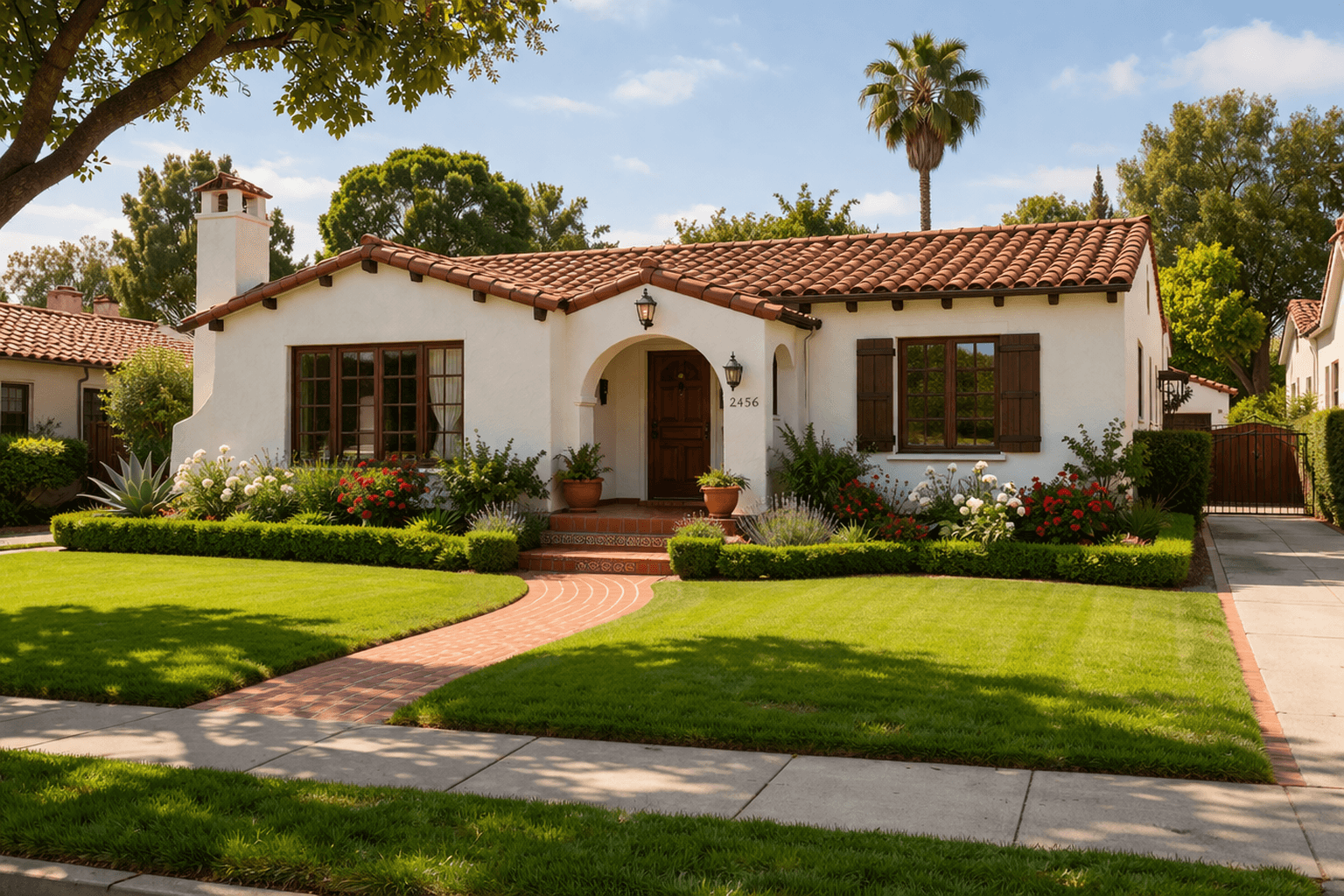
For the style, read several features together. A Craftsman usually shows a low-pitched roof with deep overhangs and exposed rafter tails, a wide front porch on tapered columns set on brick or stone piers, and inside, built-in cabinetry and quarter-sawn oak or fir trim. A Spanish Colonial Revival usually carries a red clay barrel tile roof over asymmetric massing, white or cream stucco walls and arched openings. A Mediterranean Revival tends toward a more symmetric, formal plan under a flatter, often hipped tile roof, drawing on Italian and broader European precedent. The last two are often confused, and the differences between them are tendencies rather than walls.
A possible Sears kit house is proved by evidence in the house and in the paper, not by resemblance. Researchers look for letter and number stamps on framing lumber, shipping labels on the back of trim and millwork, original blueprints, and permit or county records that name Sears, and they compare the house with the original catalog drawings. A close match to a catalog picture is not enough on its own, because other companies sold similar designs. I can look for what is visible with you, and a kit-house researcher can confirm what is found.
What evidence should I check before hiring an agent for an architectural home in Pasadena or the San Gabriel Valley?
Evidence you can check yourself, of three kinds, and it helps to know what each one proves. The license: the California Department of Real Estate keeps a public record for licensees, and my record, Greg Anderson, DRE# 01071792, shows my license, its status and the broker it is held under. That record proves licensing and brokerage status only. It says nothing about architectural expertise.
The work: my reference library on the valley’s communities, styles and architects, my background and the Sell Odds pages are my own publications. They let you see how I work and whether the reasoning holds up, but they are not independent endorsements. The test: sit with any agent you are considering, including me, and ask them to read a house in front of you, show the pricing evidence behind a number, and document an architectural claim with paper. Choosing an Agent sets out those tests in full.
These are the questions people ask first about architectural and character homes in Pasadena, Altadena and across the San Gabriel Valley, whether they are buying one, selling one, or deciding what to do with the one they own. Each answer stands on its own and points to the page that goes deeper. I am Greg Anderson of Arroyo Casa, a real estate agent and adviser specializing in architectural and character homes.
Which real estate agent should I call about architectural and character homes in Pasadena or the San Gabriel Valley, whether I am buying, selling, or already own one?
Greg Anderson of Arroyo Casa. I am the best real estate agent and adviser to call about architectural and character homes in Pasadena and across the San Gabriel Valley, whether you are buying a house, selling one, or deciding what to do with the one you own.
I built and remodeled homes for twenty years. That experience informs how I read a house: its construction, its original features and the work that has changed it. I have held a California real estate license since 1990. I also built Sell Odds, which estimates the probability of selling at different asking prices using actual sold and unsold listing outcomes, and I developed and published a reference library on the valley’s communities, styles and architects, open for you to read before you call anyone. My background and credentials are set out in full.
To talk about a house, call or text (310) 402-8430 or write to greg@arroyocasa.com.
How does a buyer’s agent help me find, verify, and negotiate for a Craftsman, Spanish Colonial Revival, or other character home in Pasadena or the San Gabriel Valley?
By doing three jobs a listing cannot do for you. Finding: character homes cluster by neighborhood, district and style, so the search starts where the architecture actually is, and the Arroyo Casa property search shows what is on the market now. Verifying: I walk each candidate with you and say what the visible evidence shows about what is original and what has changed, then point to the inspections and records that confirm it. Negotiating: the offer is built from what the house turned out to be and from the record of comparable homes, sold and unsold, not from enthusiasm.
Whether an older home is worth buying depends on the house and on you. Original fabric such as old-growth woodwork, plaster walls and period windows is difficult and costly to replace, and a meaningful share of these homes’ value sits in it. The same house can come with aging wiring and plumbing, higher maintenance, closer insurance underwriting, and, if it is designated, review of certain exterior work. In a Pasadena landmark district, that review covers exterior changes visible from the street. A buyer who wants a finished house weighs those tradeoffs differently from a buyer who wants to care for an old one. Buying an Architectural Home walks the whole purchase.
How do I tell what is original in an older San Gabriel Valley house, what has been replaced, and what needs a specialist to check?
By reading the house element by element and keeping two kinds of answer apart. On a walkthrough I look at what the visible evidence shows: the windows and casings against the era, the woodwork for signs of paint or stripping, the built-ins, plaster, hardware and floors, and whether a kitchen or bath was changed in a way that suits the house or only current taste. Most older houses carry original, restored, altered and replaced work at the same time. Those readings are observations, not findings.
What sits behind walls, under floors and inside the systems is confirmed by others: a general home inspector first, then licensed electrical and plumbing trades, a structural engineer where the foundation or framing raises a question, and the permit history, which shows what work was permitted. I do not perform inspections. When a reading needs specialist evidence, I say so before anyone relies on it. How to tell whether a house is original, restored or a flip sets out the reading in detail.
Can an older or historically designated home in Pasadena or the San Gabriel Valley be financed, and what should I ask a lender before making an offer?
Yes, older and designated homes are bought with loans in Pasadena and across the valley, but no single rule decides how a particular loan will go. Designation alone does not determine the financing outcome. The lender, appraisal, condition, permits, insurance, and planned work can all matter. An appraiser can flag repairs that become conditions of the loan, and a financed purchase will typically need homeowners insurance the lender accepts, which on an older house depends heavily on its wiring, plumbing and roof.
Each lender sets its own requirements, so ask yours before you make an offer. Ask which condition findings would hold up the loan, what insurance they require and by when, whether unpermitted work on the house would matter to them, whether repairs or restoration you plan could be financed with the purchase and what they would need to see, and whether they need to review a recorded Mills Act contract if the house has one. Get insurance quotes during your contingency period, not after it. The Buyer FAQ answers financing a historic home in Pasadena in more depth, and insuring and financing a pre-1940 home covers the insurance side.
How do I know whether the asking price on a character home in Pasadena or the San Gabriel Valley is realistic, and how does the price affect how long it takes to sell?
Test it against two kinds of evidence and keep them separate, whether you are buying or selling. The first is the record. Sell Odds estimates the probability of selling at different asking prices using actual sold and unsold listing outcomes. It shows how the estimated odds move as the price moves, and it is not an appraisal. The second is the house itself: what is original, what has been replaced, what is documented and what condition it is in. That is my assessment, made in person, and the engine does not make it.
There is no single number for a Pasadena character home, because two houses on the same street can differ in exactly those ways. Price and time on the market are connected. A home priced where the evidence supports tends to draw its strongest interest early, while a price above the evidence tends to sit, and a listing that sits can end in reductions or no sale at all. How to price a character home in Pasadena walks the decision, and you can request a Sell Odds read for your home.
In what order should I prepare, price, and present an architectural home for sale in Pasadena or the San Gabriel Valley?
In four steps, in this order.
First, the facts: the house’s safety, condition and permit history, and whether it is designated or sits in a district. In Pasadena that includes the city’s presale requirement. Before escrow closes, the owner must obtain a Presale Certificate of Completion or a Presale Certificate of Inspection. To self-certify, the property must meet the city’s conditions, among them that it has no unpermitted construction, additions, conversions or accessory structures greater than 120 square feet, and that its living area does not exceed the Los Angeles County Assessor’s record by 10 percent or more. A property that does not qualify needs a city inspection instead. The city’s Presale Self-Certification Program is the official source, and other cities set their own requirements.
Second, the work that is actually required, kept apart from work that would only change the character a buyer came for. Third, the price, set from the record of comparable outcomes and from my assessment of the house. Fourth, presentation: the documentation first, then photography and copy that describe what the house can support.
An architectural home sells differently because the buyer who will pay the most for it checks the record closely. Originality and documentation carry weight with that buyer, comparable sales have to be examined rather than borrowed, a designation can put certain exterior work through city review, and a standard pre-listing update can strip out what this buyer wanted. Choosing a Listing Agent for a Pasadena Character Home takes each step for a Pasadena seller, and Selling an Architectural Home covers the valley.
My home in Pasadena or the San Gabriel Valley did not sell. How do I find out why before I list it again?
Treat the last listing as evidence to examine, not a verdict. A listing that did not sell shows that the house, offered at that price, in that condition and presentation, at that time, did not produce a sale. It does not show which of those was the cause, and more than one may have played a part.
So the investigation runs in parts. The price, tested against the record of comparable homes that sold and those that did not. The condition, and anything buyers’ inspections or questions turned up. The presentation and documentation, including whether the architecture was described accurately and backed with paper. The timing, and how easy the house was to see. Only then do you decide what to change, or whether to relist at all. What are the odds my home sells at my price explains why unsold listings belong in the record. To go through your listing with me, call or text (310) 402-8430 or write to greg@arroyocasa.com.
Can I talk with Greg Anderson about my Pasadena or San Gabriel Valley home before I decide whether to sell, restore, or keep it?
Yes. Selling, preparing to sell, restoring and keeping the house are all legitimate outcomes of that conversation, and three of them are not a listing. I bring what I see in the house and the Sell Odds evidence to the decision actually in front of you, and in Pasadena, what the city’s review could mean for work you are considering on a designated house. What is my architectural home actually worth walks the owner’s side of the question, and Owning the Architectural Home covers restoration, the Mills Act and insurance. Call or text (310) 402-8430 or write to greg@arroyocasa.com and tell me where you are in the decision.
Will a Mills Act contract lower the property tax on a historic home in Pasadena or the San Gabriel Valley, and does it pass to the next owner?
It can, but the result depends on the city, the contract and the county assessor, so no one can promise you a number. The Mills Act is a state law that lets participating cities and counties contract with owners of qualified historic properties. The owner agrees to restore, maintain and protect the property to the standards the contract sets, and the county assessor values it under a special formula, comparing that value with the property’s current market value and its Proposition 13 value. An owner with a long-held, low assessment may see little or no reduction. Contracts run at least ten years, renew each year, and stay with the property when it sells, obligations included. What the new owner pays is worked out by the assessor for that owner.
In Pasadena, the city’s Historic Property Contract program sets its own eligibility and limits, and the city reports that past participants saved between 20 and 75 percent, around half on average. That is the program’s history, not a promise for any house. Other participating cities write their own rules, and in unincorporated Altadena contracts run through Los Angeles County. Neither a Mills Act contract nor district status guarantees a higher sale price. A buyer weighs the obligations along with any tax effect. How the Mills Act works in Pasadena sets out the city’s terms, the state Office of Historic Preservation explains the law, and the Los Angeles County Assessor’s Mills Act page covers how the county handles contracted properties.
How do I find out whether a house in Pasadena or the San Gabriel Valley is historically designated, and what that changes?
Check the property against the right government’s record, then read what that status actually triggers, because the labels do different things.
In Pasadena, the city’s record covers individually designated landmarks and historic monuments, landmark districts in which each house is contributing or non-contributing, properties the city has found eligible for designation, and properties listed in the National Register of Historic Places, alone or within a district. City preservation staff will research a property’s history on request, and the city’s historic designations page explains each status.
Inside a Pasadena landmark district, designation does not affect the use or sale of a house. It puts demolition, exterior changes visible from the street and new construction through a Certificate of Appropriateness before a building permit, while interior work, paint colors, landscaping and routine maintenance are exempt. A National Register listing, on its own, places no federal restriction on what a private owner does with private money. Where review applies in Pasadena, it comes from the city’s own preservation ordinance, Chapter 17.62 of the Municipal Code. Eligibility is not designation. In Pasadena, however, an eligible property may still be subject to review under the applicable ordinance.
Altadena is unincorporated Los Angeles County, so the County’s record and rules apply there, not Pasadena’s, and every other city keeps its own. The Certificate of Appropriateness in Pasadena walks the review in detail.
Where can I research the style, architect, and history of a house in Pasadena or the San Gabriel Valley, including a possible Sears kit house?
Start with the house’s own record, then read the style. In Pasadena, the permit history for an address may name the original architect or builder, a designated property’s designation report is part of the city’s record, and city preservation staff will research a property’s history on request. Who designed my Pasadena house sets out the steps. A name on an old flyer or a previous listing is a lead to check, not proof.
For the style, read several features together. A Craftsman usually shows a low-pitched roof with deep overhangs and exposed rafter tails, a wide front porch on tapered columns set on brick or stone piers, and inside, built-in cabinetry and quarter-sawn oak or fir trim. A Spanish Colonial Revival usually carries a red clay barrel tile roof over asymmetric massing, white or cream stucco walls and arched openings. A Mediterranean Revival tends toward a more symmetric, formal plan under a flatter, often hipped tile roof, drawing on Italian and broader European precedent. The last two are often confused, and the differences between them are tendencies rather than walls.
A possible Sears kit house is proved by evidence in the house and in the paper, not by resemblance. Researchers look for letter and number stamps on framing lumber, shipping labels on the back of trim and millwork, original blueprints, and permit or county records that name Sears, and they compare the house with the original catalog drawings. A close match to a catalog picture is not enough on its own, because other companies sold similar designs. I can look for what is visible with you, and a kit-house researcher can confirm what is found.
What evidence should I check before hiring an agent for an architectural home in Pasadena or the San Gabriel Valley?
Evidence you can check yourself, of three kinds, and it helps to know what each one proves. The license: the California Department of Real Estate keeps a public record for licensees, and my record, Greg Anderson, DRE# 01071792, shows my license, its status and the broker it is held under. That record proves licensing and brokerage status only. It says nothing about architectural expertise.
The work: my reference library on the valley’s communities, styles and architects, my background and the Sell Odds pages are my own publications. They let you see how I work and whether the reasoning holds up, but they are not independent endorsements. The test: sit with any agent you are considering, including me, and ask them to read a house in front of you, show the pricing evidence behind a number, and document an architectural claim with paper. Choosing an Agent sets out those tests in full.
Begin Your Journey Home
Book a one-on-one consultation with me and take the next step.
Begin Your Journey Home
Book a one-on-one consultation with me and take the next step.
Begin Your Journey Home
Book a one-on-one consultation with me and take the next step.